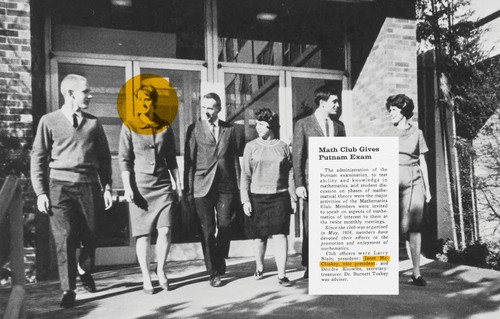
Janet Brittain, ’67, looks back on a pioneering career in aerospace and shares why she’s encouraged to see more women pursuing STEM.
When Janet Brittain graduated from Seattle University—Magna Cum Laude in 1967—with a degree in math, she contemplated her next move. Originally, she thought about graduate school as it seemed the logical next step and was even offered a teaching fellowship at Western Washington University. Though tempting, she turned it down as she was feeling “burnt out” with academia.
So, she decided to test the job market and apply for a 9 to 5. But that plan hit a snag.
“I was turned down from everywhere I applied,” says Brittain. “I was told I was overqualified, would get bored or would just get trained and then get married and quit. It was very depressing.”
Down but not defeated, she eventually ended up with a job offer from Boeing to work as a statistician. Ironically, perhaps, is that statistics was the one math class she didn’t take. But that wouldn’t be the first curveball in her new position.
“The day I started they had a big reorganization and the person that hired me was transferred to a different position,” she recalls. “I was left in a group that didn’t know what to do with me. When their secretary left, they put me in her position, having had no secretarial experience. I was not happy and eventually quit.”
But Boeing would not be her last career stop in aerospace nor the end of her being a true trailblazer as one of few women breaking barriers in male-dominated professions including at Lockheed Martin.
In this Q&A Brittain discusses more about her career and life paths, including life after Boeing, what it means to her to see so many young women pursue STEM fields and her proudest moments.
What brought you to Seattle University?
I wanted to go to a Catholic university, SU was close to home and one of my older brothers went there. Winning the President’s scholarship for my high school, Kent Meridian, was the deciding factor.
What was it like to be a student at SU in the 1960s and a woman studying math?
Although I was the only woman in most of my math classes, I seemed to fit in pretty well. Some of the classes only had three or four students. I was the only woman to graduate with a BS degree in mathematics the year I graduated.
How did you ultimately end up working for Lockheed Martin?
After leaving Boeing, I eventually got married and moved to Silverdale, Wash. After having three children and moving to Bremerton, my husband decided he wanted to go back to get his master’s degree. So, of course, I had to get a job to support the family. His mother worked at the Unemployment Office and suggested I check with the Employment Security Office to see what jobs were available in the community. I did check with them and found out that Lockheed was hiring and one position was looking for a woman with a math/science degree. I applied for that job and was interviewed. I got a job offer on my 30th birthday. The position was for an associate engineer. I was the first salaried female in this wave of hiring.
What did your job entail?
My first job was in Quality Assurance. We reviewed Trouble/Failure Inspection reports, which were written during inspection of work being done. We had to make sure they were filled out correctly and if not we sent them back to get corrected. My next job was as an internal auditor. In this job, we audited the various groups to see that they were complying with their department procedures. We had to report findings to management and help them solve their problems. My last years were spent in the Planning and Scheduling group. I had many jobs working in this group. In that time, I worked closely with people from both Lockheed and the U.S. Government and many other contractors in several states and Washington, DC.
And you were quite the trailblazer there. What was the makeup of the company when you joined? Mostly men?
When I was first hired on, there were about 30 Lockheed employees at the SUBBASE Bangor site, mostly men. I think there were three or four women, all in secretarial positions. At the time, they were hiring up for the next generation of missiles, so there were soon more women.
What are you most proud of in terms of your career and accomplishments?
I was proud of the fact that I was respected by both government and Lockheed counterparts from base captains and Lockheed resident director and managers to floor workers. When computers came on board, I basically taught myself Word, Excel, PowerPoint and more. I was also proud that I worked there for 37 years.
What does it mean to you to know that more women are studying or majoring in STEM disciplines?
I think it is wonderful to see so many young women embracing STEM disciplines. They are proving to be just as capable as men. When I worked for Lockheed, I became involved in a community project for girls in the 5th through 8th grades called Girls Exploring Math and Science.
This was an annual event for girls with workshops led by women. We had workshops dealing with normally male-oriented jobs including chemistry, engineering, robotics, cooking and carpentry. It was such a joy to see the girls come out of those workshops so excited about the subject.
For students considering STEM majors, what would be your pitch on why they should pursue this path?
There will always be a job available for persons in the STEM fields. Most jobs depend on STEM in some way, whether it is a carpenter, cook, firefighter, police officer or a train engineer. You can’t go wrong. I would also advise them to diversify their studies and take some “fun” classes so they don’t get burned out.
Similar News & Stories
-
Enduring Community Impact
Seattle University MagazineThe Seattle University Youth Initiative celebrates 15 years of supporting Seattle youth and their families. -
An Affinity for Engagement
Seattle University MagazineMeet the new assistant directors that aim to provide a more personalized, college and program specific experience for alumni. -
Safety Minded
Seattle University MagazineGet to know Seattle University’s new director of Public Safety Cheryl Logsdon and her priorities leading the department.