Managing change by removing frictions
How to overcome the workplace's four common “frictions" so that organizations can innovate and evolve.
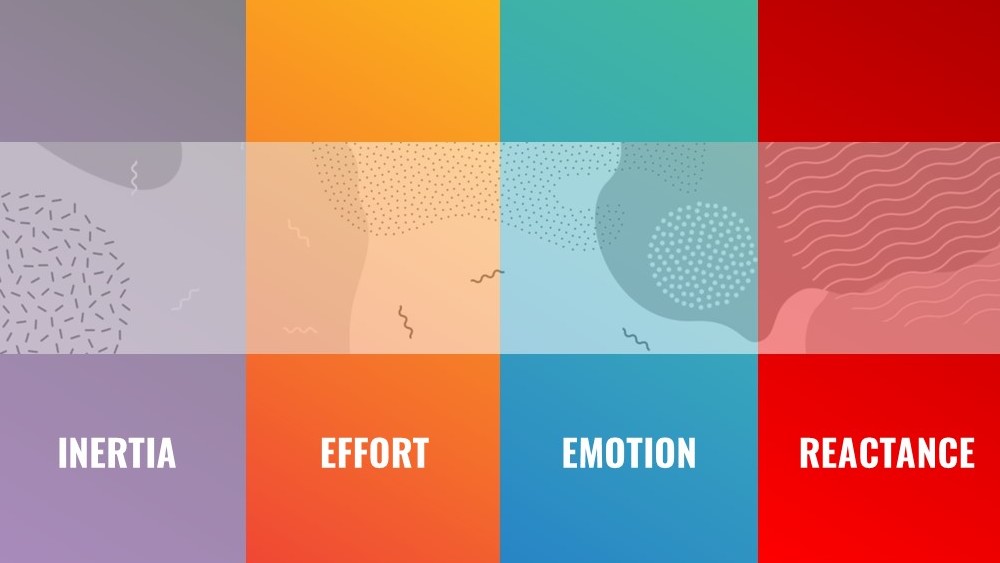
Based on the book, The Human Element: Overcoming the Resistance That Awaits New Ideas (Nordgren & Schonthal, 2021), the Center for Faculty Development has developed a self-assessment exercise and corresponding videos to help our community tackle the four frictions that can hold back innovation and creativity.
To find out more about the book, please refer to the authors' own website for the book.
What do we mean by "frictions"?
Nordgren and Schonthal (2021, p. 6) define inertia as
"The powerful desire to stick with what we know, despite the limitations."
This video explains how to overcome Inertia as a friction to organizational change and innovation.
Nordgren and Schonthal (2021, p. 6) define effort as
"The energy (real and perceived) needed to make change happen."
This video explains how to overcome Effort as a friction to organizational change and innovation.
Nordgren and Schonthal (2021, p. 6) define emotion as
"The unintended negative emotions created by the very change we seek to make."
This video explains how to overcome Emotion as a friction to organizational change and innovation.
Nordgren and Schonthal (2021, p. 6) define reactance as
"The impulse to resist being changed."
This video explains how to overcome Reactance as a friction to organizational change and innovation.
Discover your own Frictions profile below
Identifying the frictions holding a project back can be difficult, especially when we are excited about the potential of our new idea.
We're here to help!
- To help, we've created this self-assessment survey in Qualtrics for you to complete.
- Once you've completed the Qualtrics survey, enter your project's scores in the colored cells below. This will create a visual representation for you of the frictions that are most salient to your project or innovation.
- Watch the video below to explain what your visualization might mean for you.
- You can then re-watch the videos above for the frictions you'd most like to work on. We've also added a few notes below the chart for further context.
Notes
- You may feel some of the strategies are inappropriate or manipulative, especially in Seattle University's Jesuit context. (We feel the same about some of them, too!)
- We chose to not put any spin on the strategies, and instead, wanted you to know what the research suggests so that you can make your own judgments.
If you'd like to talk more about your project's frictions and/or have questions about this material, please request a consultation with the Center for Faculty Development. We'd love to hear from you about your innovation!
Discover your own project's frictions
Identifying the frictions holding a project back can be difficult, especially when we are excited about the potential of our new idea.
- To help, we've created this self-assessment survey for you to complete.
- Once you have your scores from the survey, you can use this Frictions exercise Excel document to create a visual representation of the frictions that are most salient to your project or innovation.
- Watch the relevant videos above to learn more about how you can reduce those frictions to help your project succeed.
Reference
Nordgren, L., & Schonthal, D. (2021). The human element: Overcoming the resistance that awaits new ideas. Wiley.
SU community members can access an electronic copy of the book from Lemieux Library.
And you can also refer to the authors' own website for the book to find out more.
<p><iframe src="https://cms.seattleu.edu/terminalfour/page/media#edit/9601907/smxx/general?sourcedoc={323642f2-aaec-4e56-96b6-0c7c9d3527b7}&action=embedview&wdAllowInteractivity=False&AllowTyping=True&wdHideGridlines=True&wdHideHeaders=True&wdDownloadButton=True&wdInConfigurator=True&wdInConfigurator=True&edaebf=cc" width="1200" height="600" frameborder="0" scrolling="no"></iframe></p>