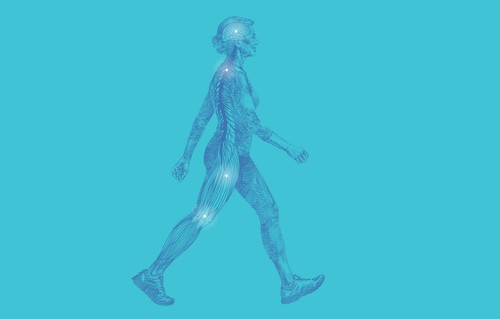
Kinesiology’s Dr. Brittany Heintz Walters explores how the brain, body and nervous system work together.
Sports have always been a central part of Dr. Brittany Heintz Walters’ life. Growing up in Milwaukee, she played ice hockey starting as a young child and through college and has been a longtime runner, including completing six marathons in six days across her home state to raise funds and awareness for multiple sclerosis research.
Being attuned to her body from the perspective of an athlete made her decision to become a scholar and professor of kinesiology—the study of the body’s movements—a natural direction when an undergraduate at the University of Wisconsin-Milwaukee, where she also earned her PhD in Kinesiology with an emphasis in Neuromechanics (she also attended the Doctor of Physical Therapy Program at the University of Texas Southwestern Medical Center.)
“My initial interest of kinesiology and understanding human movement was really through an athletics lens,” she says. “But more than just athletic performance—how the brain and nervous system and muscles all work together.”
Now in her seventh year at SU, Heintz Walters is an Associate Professor and Chair of the Kinesiology Department, teaching in the areas of neuromechanics and motor control.
Central to Heintz Walters’ work is research, which involves older adults and those with movement disorders, including stroke survivors. This involves approaching the study of human movement from various angles, including looking at how the brain obtains and processes sensory information, such as cognition and attentional processes, examining the neuromuscular system and determining how these all factor into the control of movements.
The goal is “to better understand neuromuscular changes that occur with movement impairments and to improve motor function and quality of life in older adults and patient populations,” says Heintz Walters.
“Why this area of research? … I’ve always been fascinated with the nervous system and its role in controlling movement,” she continues. “Healthy aging provides a meaningful way to explore the relationship between movement and control, including understanding the nervous system across the lifespan. Movement is fundamental, everyday activities that can be taken for granted—walking, picking up a cup, even talking—if we have changes to the control of these movements it can significantly impact day-to-day function and quality of life.”
A second area of research that Heintz Walters is doing, in conjunction with Professor Yen-Lin Han, PhD, who is chair of mechanical engineering and has done extensive research—and has patents—is related to soft robotics for movement rehabilitation. This partnership is an example of meaningful interdisciplinary collaboration.
The study of kinesiology has evolved over the years, increasingly becoming more encompassing to include fitness and wellness, athletic performance and public health. “Rather than just focusing on movement in isolation,” says Heintz Walters, “it has broadened to consider the whole person.”
Last academic year kinesiology moved to the College of Nursing and Health Sciences, which affords more opportunities for research and to work with nursing, ultrasound and health care students and faculty, aligning closely with workforce needs.
Community outreach is also an important part of the hands-on, experiential learning that kinesiology students engage in. Here is where the program’s mobile lab, which Heintz Walters launched during the 2021-22 academic year, comes into play. The lab is a van equipped with state-of-the-art research equipment that is dispatched to different neighborhoods and community centers in the Seattle area.
“Our mobile lab is really a classroom, research space and community resource on wheels,” says Heintz Walters. “It gives us the flexibility to bring state-of-the-art movement assessment and research tools beyond the university and into the communities we serve. For our students, it’s an opportunity to learn by doing, complementing the experiences they gain in our brand-new Human Performance Lab. For the community, it creates a more direct connection to the expertise and resources available through kinesiology.”
Beyond teaching and the research, Heintz Walters says the rewards of her work is engaging with students, who bring diverse experiences, curiosity and a desire to learn, supported by faculty and staff who mentor them “as they discover what they are capable of.”
At the heart of our programs, she says, is an emphasis on hands-on learning and a simple philosophy: “exercise for life, exercise for everyone is our message.”
When not teaching or conducting research, Heintz Walters loves spending time with her four-year-old son and her dog, Moose, and can often be found exploring the outdoors. And it’s no surprise that being active is among her main hobbies, including endurance running and hiking throughout the Northwest.
Similar News & Stories
-

Saheed Adejumobi, PhD, Associate Professor of History and African and African American Studies, Appointed to Pigott McCone Chair
SU NewsTwo-year project will focus on intersections in the work of W.E.B. Du Bois and Dr. Quintard Taylor -
SU Names New Associate Vice Provost
SU NewsDr. Mason M. Moore will also serve as Chief of Staff for the provost. -
South Seattle Emerald: Computer Science Chair Burkhard Englert on Data Centers
Campus News, In the NewsComputer Science Chair Burkhard Englert is interviewed about the impact of data centers on local power and water supplies.